Support & Services
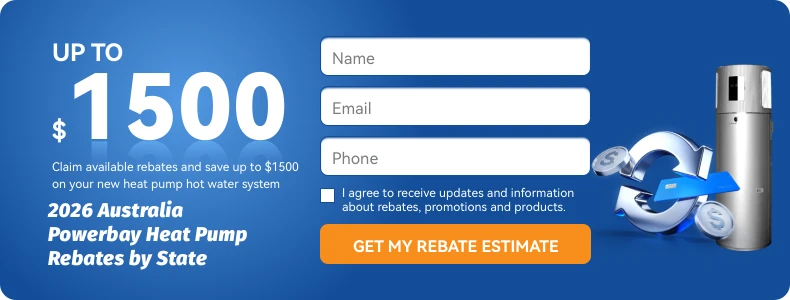
Australia Heat Pump Rebates by State
Estimated rebate amounts, stackable incentives, and eligibility information for each state.
Amount: Up to $1500
Rebates are stackable:
٠STCs
٠VEECs (VEU)
٠Solar Victoria Hot Water
Amount: Up to $1000
Rebates are stackable:
٠STCs
٠ESC
SA Amount: Up to $800
Rebates are stackable:
٠STCs
٠REPS
QLD/WA/TAS/NT/ACT:
٠Federal STCs apply nationally
Key Point: Rebate figures are indicative only and may change without notice. Final rebate values may vary depending on installation location, eligibility, government scheme requirements, and certificate market pricing.
Rebate Programs Explained
A Small-scale Technology Certificate (STC) is the equivalent of one megawatt hour of renewable energy generation. A Small-scale Technology Certificate (STC) is the equivalent of one megawatt hour of renewable energy generation.
| STC Certificate Value for Year 2026 | ||||||
|---|---|---|---|---|---|---|
| Model | Zone1 | Zone2 | Zone3 | Zone4 | Zone5 | |
| PBG2-200RE-HYBRID | 13 | 13 | 16 | 17 | 17 | |
| PBG2-300RE-HYBRID | 13 | 13 | 16 | 17 | 16 | |
Notes: This table outlines the estimated number of STCs registered by The Clean Energy Regulator (CER) for eligible Powerbay Heat Pump Hot Water Systems.
STC values are subject to change and may vary based on installation postcode, climate zone, applicable government regulations, and market fluctuations. The figures shown above are provided as an estimate only.
VEECs are rebates awarded under the Victorian Energy Upgrade (VEU) program, (previously known as the Victorian Energy Efficiency Target, VEET) which aims to reduce the overall carbon footprint of Victoria.
The Victorian government provides VEECs to households in Victoria who are replacing inefficient appliances with new energy-efficient ones. Each VEEC represents one tonne of greenhouse gas prevented from entering our atmosphere.
This table shows the estimated VEECs available for different Powerbay heat pump models across Victorian regions when replacing electric or gas hot water systems.
| VEECs Calculator : 1D-Heat pump replacing electric resistance | ||||||
|---|---|---|---|---|---|---|
| Regional/Metro | Metro | Regional | ||||
| PBG2-200RE-HYBRID | 10 | 10 | ||||
| PBG2-300RE-HYBRID | 9 | 9/10 | ||||
| VEECs Calculator : 3C-Heat pump replacing gas | ||||||
|---|---|---|---|---|---|---|
| Regional/Metro | Metro | Regional | ||||
| PBG2-200RE-HYBRID | 9 | 8/9 | ||||
| PBG2-300RE-HYBRID | 8 | 8 | ||||
Notes:For more information on VEECs visit the VEU website, or find out your VEEC eligibility with the
VEU VEEC calculator.
VEEC values and rebate amounts are subject to change based on government regulations, installation details, and market fluctuations.
The Solar Victoria Hot Water Rebate is a government initiative designed to encourage the installation of solar hot water systems and heat pump systems in homes across Victoria. It helps reduce the upfront cost of installation, making it more affordable for homeowners. Eligible homeowners can receive a rebate of up to $1,000 towards the cost of installing a solar hot water system or heat pump. To qualify for the rebate for applications submitted on or after 1 July 2026, applicants must meet the updated eligibility criteria:
- You are the owner-occupier of an existing property where the system is to be installed.
- The household taxable income of all owners combined is less than $150,000 per year.
- The value of the property is under $3 million.
- the property address has not already received a hot water or a solar battery rebate under the Solar Homes Program.
- The hot water system to be replaced is at least 3 years old from the date of purchase.
- You received a Solar Homes rebate and/or loan but have moved house. You can apply for another incentive at your new address as an owner-occupier if the property has not received these rebates before.
Find out more about the Hot water rebate.
New South Wales households and small businesses may be eligible for additional rebates through the NSW Energy Savings Scheme (ESS) when replacing an existing electric or gas hot water system with an approved heat pump water heater. Under this program, Accredited Certificate Providers (ACPs) can create Energy Savings Certificates (ESCs) based on the projected energy savings achieved by the upgrade, helping reduce the upfront installation cost of eligible systems.
Learn more about the NSW ESC scheme on the Official government website .
The REPS is a South Australian Government energy productivity scheme that provides incentives for South Australian households and businesses to save energy.
The Retailer Energy Productivity Scheme (REPS) is the updated version of the REES scheme. The new scheme is a South Australian Government energy efficiency initiative that provides incentives for South Australian households and businesses to save energy. It does this through establishing energy efficiency and audit targets to be met by electricity and gas retailers.
Click here to learn more about the South Australia REPS program.
Rebate Programs Explained
A Small-scale Technology Certificate (STC) is the equivalent of one megawatt hour of renewable energy generation. A Small-scale Technology Certificate (STC) is the equivalent of one megawatt hour of renewable energy generation.
| Battery | STC Certificate Value for Year 2026 |
|---|---|
| ASW5120-LB-G3 5.12KWH | 33 |
| ASW5120-LB-G3 10.24KWH | 66 |
| ASW5120-LB-G3 20.48KWH | 117 |
| Ai-HB 100A | 67 |
| Ai-HB 200A | 113 |
Notes: This table outlines the estimated number of STCs registered by The Clean Energy Regulator (CER) for eligible Powerbay Heat Pump Hot Water Systems.
STC values are subject to change and may vary based on installation postcode, climate zone, applicable government regulations, and market fluctuations. The figures shown above are provided as an estimate only.
In Western Australia, the Residential Battery Scheme offers rebates and interest-free loans to support household battery installations. To be eligible, participants must join a Virtual Power Plant (VPP) program, allowing their battery systems to support grid stability during peak demand. The scheme can be combined with the federal Small-scale Technology Certificates (STC) incentive to further reduce upfront costs.
Click here to learn more about the official details of the WA Residential Battery Scheme.
Rebate Programs Explained
The Small-scale Technology Certificate (STC) scheme is an Australian federal government rebate that significantly reduces the upfront cost of solar installations, typically saving households thousands. For 2026, a standard 6.6kW system offers a rebate around $1,600, applied as an instant discount by installers, though this value steps down annually until 2030.
| Solar Panel | ||||||
|---|---|---|---|---|---|---|
| 6.66KW | 10.12KW | 13.20KW | ||||
| Sydney 2000 | 46 | 69 | 91 | |||
| Melbourne 3000 | 39 | 59 | 78 | |||
| Brisbane 4000 | 46 | 69 | 91 | |||
| Perth 6000 | 46 | 69 | 91 | |||
| Adelaide 5000 | 46 | 69 | 91 | |||
| Canberra 2600 / 2601 | 46 | 69 | 91 | |||
| Hobart 7000 | 39 | 59 | 91 | |||
| Darwin 0800 | 51 | 77 | 101 | |||
Notes: This table outlines the estimated number of STCs registered by Clean Energy Regulator for eligible Powerbay Solar PV Systems, including approved solar panels and inverter configurations.Rebate figures are indicative only and may change without notice. Final rebate values may vary depending on installation location, eligibility, government scheme requirements, and certificate market pricing.
The Solar Victoria Solar Panel (PV) Rebate is a Victorian Government incentive designed to help eligible households reduce the upfront cost of installing rooftop solar systems. The program supports homeowners in transitioning to clean, renewable energy while lowering long-term electricity bills.
Eligible Victorian households can currently access:
- Up to $1,400 Solar PV rebate
- An optional interest-free loanequal to the rebate amount
- Additional savings through the Australian Government’s STC (Small-scale Technology Certificates)program
To qualify, applicants generally must:
- Own and live in the property
- Have a combined household income below the program threshold
- Use a CEC-approved solar system and accredited installer
- Install the system through an authorised Solar Victoria retailer
Find out more about the Solar panel (PV) rebate.